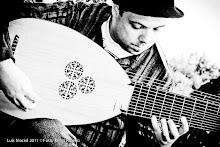
Given the interest shown in the work of the lutenist Miguel Yisrael, his two excellent CDs and specially his "method of the baroque lute", which is the most read topic in this blog, I leave available here some of his videos, other are available on youtube. Take a few minutes of your day to enjoy this sound
www.miguelyisrael.com
(português)
Devido ao interesse mostrado no alaúdista Miguel Yisrael, aos seus dois excelentes CDs e sobretudo ao seu livro "método do alaúde barroco", que é tópico de leitura mais lido neste blog, deixo disponíveis aqui alguns videos seus, outros estão disponíveis no youtube. Tire alguns minutos do seu dia para disfrutar deste som.
www.miguelyisrael.com
Sylvius Leopold Weiss - Passacaglia in D Major
Sylvius Leopold Weiss - Passacaglia - Les Baricades Mistérieuses
Jacques Gallot - Les Folies d'Espagne
Showing posts with label Brilliant Classics. Show all posts
Showing posts with label Brilliant Classics. Show all posts
Sunday, March 14, 2010


Monday, June 8, 2009
Method for the Baroque Lute | Método de Alaúde Barroco
 Miguel Yisrael is a Portuguese lutenist based in Paris, who launched his first CD in 2008 through the Dutch label "Brilliant Classics".
He earned his degree in classical guitar in 1994 and in the following year he moved to Paris where he studied lute with Claire Antonini in the Department of Early Music of the "Conservatoire Supérieur de Paris - CNR”, and from 1999 to 2004, completed his studies at the Schola Cantorum Basiliensis in Basel-Switzerland, with the mythical Hopkinson Smith. Miguel Yisrael appears as a soloist in recitals around the world.
Miguel Yisrael is now launching a method for the baroque lute, which is truly unique in the panorama of Early music. Much like this blog, the method is aimed at a wide range of people interested in the lute, from the experienced players, to beginners and those who are still considering learning.
The publication is divided into three parts: the first is primarily theoretical, including explanation of tablature, understanding of the instrument and biographies of musicians. The second part is directed to the study of the technique and production of sound, having 21 elementary exercises of increasing difficulty at the end and a few pieces. The third and last part contains 250 selected pieces for the 11 and 13-course baroque lute, divided into 3 levels of difficulty.
As a personal opinion, I ordered this book and it is excellent. You cannot get the richness and detail of information nowadays, compiled and taught in a clear and objective way, better than this. Already indispensable for a modern lute student and maybe your best solution if you do not have the privilege of having a lute teacher relatively close to your home.
The method of Baroque lute includes dozens of photos in detail, and is available in English and French. 356 pages - Editions "Ut Orpheus", Italy, 2008.
(português)
Miguel Yisrael é um alaúdista português com base em Paris, que lançou o seu primeiro CD em 2008 pela distribuidora holandesa “Brilliant Classics”.
Obteve o seu diploma em guitarra clássica, em 1994 e no ano seguinte mudou-se para Paris onde estudou alaúde com Claire Antonini no Departamento de Música Antiga do “Conservatoire Supérieur de Paris”-CNR, e de 1999 a 2004, completou os seus estudos na Schola Cantorum Basiliensis, em Basel na Suíça, com o mítico Hopkinson Smith. Miguel Yisrael apresenta-se como solista em recitais por todo o mundo.
Miguel Yisrael lança agora um método para alaúde barroco, que é verdadeiramente original no panorama da música antiga. Muito como este blog, o método é voltado para um leque alargado de pessoas interessadas no alaúde, desde os músicos experimentados, até aos iniciantes e àqueles que ainda estão considerando aprender.
A publicação está dividida em três partes: a primeira é, sobretudo teórica, incluindo explicação sobre tablatura, compreensão do instrumento e biografias de músicos. A segunda parte é direcionada para o estudo da técnica e produção do som, tendo no final, 21 exercícios elementares de dificuldade crescente e algumas peças. A terceira e última parte contem 250 peças selecionadas para o alaúde barroco de 11 e 13 ordens, divididas em 3 graus de dificuldade.
A título de opinião pessoal, encomendei este livro e ele é excelente. Você não poderá obter esta riqueza e detalhe informativo hoje em dia, compilado e ensinado clara e objetivamente, de uma maneira melhor que esta. Já indispensável para um estudante de alaúde moderno e talvez a sua melhor solução, se não tiver o privilégio de ter professor relativamente perto de sua casa.
O método de Alaúde Barroco inclui dezenas de fotos em detalhe, e está disponível em inglês e francês. 356 páginas - Edições “Ut Orpheus”, Itália, 2008.
Subscribe to:
Posts (Atom)