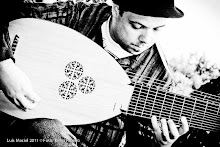
During this week I was on stage in the Early Music students Audition, at the Music School of Brasilia (EMB). The first time I played in public was at the end of the first half of 2008, and the experience was the basis for the post of April 2009 in this blog, titled "The nervousness of a recital."
My presentation had as main pieces, two lute duets with my colleague Tiago, of the group practice classes: "Queen's Treble" by John Johnson, and "A Toy", by Thomas Robinson. Both duos have a continuous solo, with each lutenist soloing and accompanying three times alternately. In addition, each of the musicians had to play 3 to 4 individual pieces.
In the two or three classes before the audition, I tried to exchange some ideas with the teacher about the psychological part that affected me so much the first time, and assimilated some important tips to implant in my head. I practiced and improved the pieces that I would have to play until I played them well and have some margin for error or nervousism. Two or three days before the audition I delivered myself to a new idea, a psychological inversion: Instead of entering into the anguishing countdown to get on the scaffold-stage, I started thinking just the opposite - I WANTED to be on stage, and I barely could wait for it. I Visualized myself in silent protests "What about me? I want to play too! It’s me now. "
The day of the hearing came and I went to EMB as in a normal lute class day, with confortable clothes and without being dressed as a choirboy, with shiny torture shoes. Just talked to three people about the event, I did not care what the audience would think about me and didn’t want to document anything with pictures. In fact, I didn’t shave, perhaps to convince myself that I didn’t take the audition as a matter of life and death. I believe that these small measures have helped me at this stage to normalize a kind of presentation that will become more frequent in the future, and in the end, I was quite surprised at my tranquility.
The hearing was held in the Theatre Hall of EMB, a larger place and with much better acoustics and comfort for the audience. It got to be delicious to make a sort of "sound check" on stage, while some public arrived. When the presentations began, by my count there should be at least 80 people watching, which represented a huge increase for me since the first time. I began to feel some anxiety and some moisture on the hands, but the strangest thing was when I had a sudden attack of sleep about five minutes from my turn, which made me make a lightning-pause for a 10 second coffee.
At the stage, although relatively calm, I noticed that the moisture of my hands was now cold. I paused and began. I was pleased with the choice for first song, with which I felt very comfortable, and so played by heart without tablature. I found myself with enough ease to make pauses in breathing and close my eyes when I wanted. I was testing myself, and knowingly I didn’t feel nervous.
I played my other pieces, including "Tant que vivray" by Claudin de Sermisy / Pierre Attaingnant, which due to its increased difficulty I feared could become a cacophony of sounds of shaky fingers on wrong strings, but I did well. At the end of my presentation I must have made 3 minor errors in four songs, but I don’t know if most people noticed, and if they did, perhaps they did it by looking at my facial expressions.
When I finished, I received applause which I thanked and called Tiago for the duos. Perhaps because we are not yet technical course students as most of the excellent musicians who performed, I noticed the public smiling a lot. Initially I thought it was out of sympathy and condescension towards us, but then realized that us two together on stage had increased our confidence and we took a clearer sound of the lute, and in the end, it must have closed our presentation with the satisfaction of the audience. I was happy to have improved considerably since the first time, to have pleased the public and not have let the teacher down.
The main experience that I took from this event was that of at the middle of my songs and with the lack of panic, having started to have a powerful and new feeling: I was having fun being in that place. A feeling that made me wish for the next audition.
I also give importance to the class days at EMB, when I sit on a bench to play the songs as dozens of students pass. Some stop to listen or ask about the exotic instrument, an habit of playing for people grows.
Over time and with the experience and intimacy gained on the instrument, people around fall to a secondary level, and the musician-instrument pair sails alone in the sound, travels in time or stays in an introspective moment, even surrounded by audience. It got me the idea that this feeling brought to the stage, is nothing more than concentration.
For Eternity: “Every adversity has the seed of an equivalent or greater benefit” – Napoleon Hill
Português
Durante esta semana me apresentei em palco na Audição de alunos de Música Antiga, na Escola de Música de Brasília (EMB). A primeira vez que tinha tocado em público foi no final do primeiro semestre de 2008, e a experiência serviu de base para o post de Abril de 2009 neste blog, intitulado “O nervosismo de um recital”.
A minha apresentação tinha como peças principais, dois duos de alaúde com o meu colega Tiago, das aulas de prática de conjunto: “Queen’s Treble”, de John Johnson, e “A Toy”, de Thomas Robinson. Os duos têm um solo contínuo, com cada alaúdista solando e fazendo o acompanhamento alternadamente por três vezes. Além disso, cada um dos músicos tinha de apresentar de 3 a 4 peças individuais.
Nas duas ou três aulas antes da apresentação, procurei trocar algumas idéias com o professor sobre a parte psicológica que tanto me afetou da primeira vez, e consegui assimilar algumas dicas importantes para implantar na minha cabeça. Fui praticando e melhorando as peças que teria de apresentar até as tocar bem e poder ter alguma margem para erro ou nervoso. Foi a dois ou três dias da audição que me entreguei a uma nova idéia, uma inversão psicológica: Em lugar de entrar em angustiante contagem decrescente para subir ao palco-cadafalso, comecei a pensar justamente o oposto – Eu QUERIA estar em palco, e mal podia esperar a hora. Visualizava-me em protestos silenciosos de “e eu? Também quero tocar! Agora sou eu!”.
O dia da Audição chegou e eu fui para a EMB como num dia de aula normal, com roupa confortável e sem estar vestido de menino de coro, com sapatos brilhantes e torturadores. Apenas falei do evento a três pessoas, não me preocupei no que pensaria a platéia sobre mim e nem quis documentar nada com fotos. De fato, nem me barbeei, talvez para me convencer que não levava a Audição como assunto de vida ou morte. Creio que essas pequenas medidas me ajudaram nesta fase a normalizar um tipo de apresentação que se tornará mais freqüente no futuro, e no final de contas, fiquei bastante surpreendido com a minha tranqüilidade.
A Audição realizou-se no Teatro de Câmara da EMB, um local mais amplo e com muito melhores condições de acústica e conforto para a platéia. Chegou a ser delicioso fazer uma espécie de “sound check” em palco, enquanto algum público chegava. Quando começaram as apresentações, pelas minhas contas deveriam estar umas 80 pessoas no mínimo a assistir, o que representou um aumento enorme para mim desde a primeira vez. Comecei a sentir alguma ansiedade e alguma umidade nas mãos, mas o mais estranho foi ter tido um súbito ataque de sono a cinco minutos da minha vez, o que me fez fazer uma pausa-relâmpago para um café de dez segundos.
Ao subir ao palco, embora relativamente tranqüilo, reparei que a umidade das minhas mãos era agora gelada. Fiz uma pausa e comecei. Fiquei contente com a escolha da primeira música, com a qual me sinto muito confortável, e por isso toquei de cor sem tablatura. Dei por mim com a tranqüilidade suficiente para fazer as pausas que quis para respirar e até fechar os olhos quando quis. Estava me testando, e conscientemente não me sentia nervoso.
Toquei as minhas outras peças, incluindo o “Tant que Vivray”, de Claudin de Sermisy / Pierre Attaingnant, que devido à maior dificuldade eu temia se tornar numa cacofonia de sons de dedos tremidos em cordas erradas, mas saiu bem. No final da minha apresentação talvez tenha dado uns 3 pequenos erros em 4 músicas, mas não sei se a maioria das pessoas reparou, e se o fez talvez tenha sabido pelas minhas expressões faciais.
Quando acabei, recebi palmas, agradeci e chamei o Tiago para fazermos os duos. Talvez por ainda não sermos alunos do curso técnico como a maioria dos excelentes músicos que se apresentaram, reparei que o público sorria bastante. Inicialmente achei que era por simpatia e condescendência para conosco, mas depois realizei que os dois juntos em palco fez aumentar a nossa confiança e tirar um som mais claro do alaúde, e no final de contas, isso terá fechado a nossa apresentação com o agrado da audiência. Fiquei feliz por ter melhorado muito desde a primeira vez, de ter agradado ao público e de não ter deixado ficar mal o professor.
A principal experiência que retirei deste evento, foi a de a meio das minhas músicas e com a ausência de pânico, ter passado a sentir uma sensação nova e poderosa: Eu estava me divertindo de estar naquele lugar. Um sentimento que me fez desejar a próxima audição.
Dou também importância aos dias de aulas na EMB, em que me sento num banco a tocar as músicas enquanto passam dezenas de alunos. Alguns param para escutar ou perguntar sobre o exótico instrumento, vai crescendo um hábito de tocar para pessoas.
Ao longo do tempo, e com a experiência e intimidade ganha com o instrumento, as pessoas em volta passam para um plano mais secundário, e o par músico-instrumento navega sozinho no som, viaja no tempo ou fica num momento de introspecção, mesmo rodeado de público. Ficou-me a idéia que esse sentimento trazido para o palco, nada mais é que a concentração.
Para a Eternidade: “Toda a adversidade trás a semente de um benefício equivalente ou maior”. – Napoleon Hill