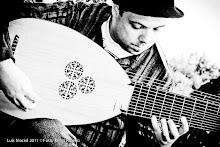
The european lute was born from the modification of an Arabic instrument called 'ud (al'ud), which is still popular in Arab countries nowadays. Al'ud means "the wooden one", which probably was used to distinguish it from other instruments made of other materials. The 'ud was introduced in Europe during the Moorish occupation of the Iberian Peninsula (711-1248 -> Portugal / 711-1492 -> Spain). Some sources believe that it may have entered Europe through the Byzantines in Sicily, or crusaders from the Holy Land, however, the european iconography of the period shows Islamic lutenists in the ninth and tenth Centuries aswell as the famous lutenist “Ziryab” in the court of ‘Abd al Rahman II (822-852) in Andalucia.
During the medieval period, the lute, which had 5 pairs of strings, or courses, was played with a quill as the 'ud, which limited the type of music that could be played and so, the lute was often played together with other instruments, especially to accompany songs. However the use of the 'ud was not restricted to Muslims as shown in illustrations of the "songs of Santa Maria" of Alfonso X the Wise (1221-1284). In the fourteenth Century, a new special writing for lute music was invented, called tablature, in which are given the positions of the fingers. Four main types of tablature were developed: the German, whose creator was Conrad Paulmann, the French, Italian and Spanish. With the new writing and the fingertips technique, an opportunity was created to make arrangements of vocal music (mostly polyphonic). There were so many arrangements that soon lutenists were able to create music generated in their own minds, thus creating a new music: The instrumental music for lute. However, that wouldn’t be possible without the close cooperation of lute manufacturers. We can highlight the most important ones of the period: Laux Maler, Hans Frei, Nicola Sconvelt, Magno Tieffenbrucker and Michael Hartung.
Another important factor in spreading the music of instrumental lute was the publishing of works of great masters by the hands of Ottaviano Petrucci, Antonio Gardano and Girolamo Scotto.
The lute really started to be important at the end of the fifteenth Century, when it was realized that it could be played with fingertips instead of a quill. This meant that the music composed in parts could now be played on the instrument. With the addition of a sixth bass course (pair of strings), the development of a more elegant and elongated body shape and the invention of a tablature system for musical notation, the lute reached its classical perfection and the stage was mounted to a music scene that would last more than 150 years. It is not difficult to see the appeal of the instrument. Lightweight and portable, a much cheaper and easier instrument to maintain than keyboards, it was very versatile - it was used for playing dance music, popular tunes, arrangements of vocal music and accompanying songs, and soon generated a solo repertoire of its own, in form of preludes, passemezzi and the most refined fantasies. It was considered the heir to the Roman Cithara or lira, which gave him even more fame in an era of obsession with classical literature.
Above all, it was the enchanting sound of the lute that turned it so admired. While its format is close to the modern guitar, the sound is very different. The resonance of its body in a half-pear and the less stressed strings give the lute a delicacy and richness that can not be compared with the modern guitar. It is in essence an instrument closer to nature than the modern guitar. The main genres of music from the Renaissance period are the dance, the forms and arrangements of imitative vocal music. The major composers of the Renaissance period were: In Italy, Francesco da Milano amd Vincenzo Galilei, in France: Adrian Leroy, in England: John Dowland and in Germany: Hans Newsidler.
At the end of the sixteenth century, experiences and innovations began to be made. A seventh course was added, then an eighth, then a ninth, eventually reaching 14 courses (pairs of strings) - the intention was partly to increase the range of the instrument to be able to play in a low register when accompanying male singers. To have the extra strings, it was included a new pegbox and a longer neck. New tuning schemes appeared. From these experiences, a new variety of instruments appeared, called “baroque lutes” today. The biggest of all, the Theorbo or Chitarrone was a bass instrument, used for accompanying, with a longer second neck that often makes the instrument longer than the musician that plays it. In France, a minor instrument of 11, 12 or 13 courses tended to be favored, the first 7 courses could be stopped with the left hand and the other strings are played openly like the strings of the harp. At the beginning of the seventeenth century a new musical aesthetic made a new musical style(homophonic) appear and with that, further refinements and new tunings had to be developed to meet this new way of making music.
French lutenists researched and developed several tunings which were known at the time as "French lute. In the middle of the seventeenth century it was the pattern tuning in D minor that made history as the "Baroque tuning". The main feature of the music of this period was the convention to play certain passages between the soprano and bass not simultaneously as in the polyphonic style, but successively, which greatly influenced harpsichord composers and which became known as "Style Brisée. The major composers of the period was Robert Ballard, Charles Mouton and Denis Gaultier. The music of this period, with its technical refinements and tunings, influenced the German lutenists in the 1680-1750 period. After an interval of relative inactivity, the composers experienced a revival of interest in the lute. Among these composers we can highlight Le Sage de Richée (born 1695), Ernst Baron (1696-1760), Adam Fackenhagen (works published in 1742 and manuscript of 1756), Jacques Bittner (work published in 1682 and 1683) and Sylvius Leopold Weiss (1687-1750) the most prolific composer of the period. These were joined by the divine J.S.Bach which contributed much to the lute music including the instrument in his “Funeral Ode” and St. John and St. Matthew Passions. The compositions of this period often take the form of a suite, starting with a prelude and continuing with dances selected among the ones in fashion at the moment such as the Courante, the Polonaise, the Allemande, the Minuet and the Gigue.
However, at the end of the XVII Century, the days of the lute were clearly numbered. The emergence of orchestras, operas and commercial concert halls placed the lute in great disadvantage - It simply could not be heard in a big noisy hall. The rising standard of living of the people also meant that more people had money to buy keyboards, which were easier to play and made possible to perform more complex harmonies. Furthermore, the extreme difficulty of playing the lute made other musicians turn to the 5 order baroque guitar. After 1760, few compositions for lute were made and the last publishing was in 1780.
In the nineteenth century, it was almost forgotten, being preserved and played only in a small circle of british intellectuals. In the twentieth century, the trajectory of the instrument was recovered and music history researched.
Today it is an instrument very valued by musicians in general but also by listeners. In the 70s, recordings by Julian Bream benefited immensely the lute, and fortunately the standard of quality is very high with regard to interpretation of lute music and the building of instruments, after models of the age. Today, ¾ of lutenists are ex-guitarists who were seduced by the Richness of the lute repertoire.
The lute witnessed a succession of the Golden Eras of composition. The first of these was in Renaissance Italy, where the great lutenist Francesco da Milano (1497-1543) divided with Michelangelo the nickname of "Il Divino" (the divine one). It was said that when he played, all thoughts passed through Paradise. In the middle of the sixteenth century, Spain produced a school of great composers, playing the "vihuela" (See “The Vihuela A Vihuela”) whose compositions are well known to today’s guitarists. The next high point came in Elizabethan England, with the sweet and melancholic fantasies of John Dowland and his contemporaries. The baroque lute produced two major schools of composition: the French, in the middle of the seventeenth century, where Gaultiers, Dufault and De Visée and others created an stately and self-confident style of music; and early in the eighteenth century Germany, where J.S.Bach composed for lute, and and the most well-succeded lutenist and composer of all times lived, Sylvius Leopold Weiss, bringing his arpeggiato style to the maximum of beauty humanely possible.
This article is based on several sources available on the Internet. I don't do historical research on the lute and I believe that history can not be invented. In these circumstances, my intention is only to disclose and make known the lute to more people, complementing this blog with some historical information.
Recommended Music:
Dowland, John - Complete Lute Works - Paul O'Dette - Harmonia Mundi
(português)
O alaúde europeu nasceu da modificação de um instrumento árabe chamado ‘ud (al’ud), que é ainda popular nos países árabes até aos dias de hoje. Al’ud significa “o de madeira”, que provavelmente serviu para o distinguir de outros instrumentos feitos com outros materiais. O ‘ud foi introduzido na Europa durante a ocupação moura da Península Ibérica (711-1248 > Portugal / 711-1492 > Espanha). Algumas fontes acreditam também que possa ter entrado na Europa através dos bizantinos na Sicília, ou por cruzados vindos da Terra Santa, no entanto, a iconografia européia do período mostra alaúdistas islâmicos nos séculos IX e X e também o famoso Ziryab na corte de ‘Abd al Rahman II (822-852), na Andaluzia.
Durante o período medieval, o alaúde, que tinha 5 pares de cordas, ou ordens, era tocado com uma palheta, como o ‘ud, o que limitava o tipo de música que poderia ser tocada e assim o alaúde era freqüentemente tocado em conjunto com outros instrumentos, sobretudo para acompanhar canções.
Entretanto o uso do ‘ud não ficou restrito aos muçulmanos como mostram ilustrações das “cantigas de Santa Maria” de Alfonso X, o Sábio (1221-1284).
No século XIV foi inventada uma escrita especial para a música de alaúde, chamada tablatura, na qual são dadas as posições dos dedos. Quatro tipos principais de tablatura foram desenvolvidos: a alemã, cujo criador foi Conrad Paulmann, a francesa, a italiana e a espanhola. Com a nova escrita e com a técnica de figueta criou-se logo a possibilidade de fazer arranjos de música vocal (essencialmente polifônica). Foram tantos arranjos que logo os alaúdistas estavam aptos a criar músicas a partir de um material engendrado em suas próprias cabeças, criando assim, uma nova música: A música instrumental de alaúde. Entretanto, nada disso seria possível sem a estreita colaboração dos fabricantes de alaúdes. Podemos destacar como os mais importantes do período: Laux Maler, Hans Frei, Nicola Sconvelt, Magno Tieffenbrucker e Michael Hartung.
Outro importante fator de disseminação da música instrumental de alaúde foi a edição de obras de grandes mestres pelas mãos de Ottaviano Petrucci, Antonio Gardano e Girolamo Scotto.
O alaúde realmente passou a ganhar uma grande importância em finais do século XV quando se compreendeu que poderia ser tocado com a ponta dos dedos em vez de palheta. Isto significava que a música composta em partes poderia agora ser tocada no instrumento. Com a adição de um sexto par de cordas baixo (ordem), o desenvolvimento de um formato mais elegante e alongado e a invenção de um sistema de tablatura para notação musical, o alaúde atingiu a perfeição clássica e o palco estava montado para um cenário musical que iria durar mais de 150 anos.
Não é difícil ver o apelo do instrumento. Leve e portátil, um instrumento muito mais barato e fácil de manter do que teclados, era muito versátil – era usado para tocar música de dança, música popular, arranjos de música vocal e acompanhamento de canções, e logo gerou um repertório solo próprio, em forma de prelúdios, passemezzi e as mais refinadas fantasias.
Era considerado o herdeiro da citara ou lira romana, o que ainda lhe dava mais fama, numa era de obsessão pela literatura clássica.
Acima de tudo, foi o som encantador do alaúde que o tornou tão admirado. Enquanto o seu formato é relativamente parecido com a guitarra moderna, o som é muito diferente. A ressonância do seu corpo em meia-pêra e as cordas menos tencionadas dão ao alaúde uma delicadeza e riqueza que não se pode comparar com a guitarra moderna. É em essência um instrumento mais próximo da Natureza do que a guitarra moderna.
Os principais gêneros de música do período renascentista são a dança,as formas imitativas e os arranjos de música vocal. Os principais compositores do período renascentista foram: na Itália, Francesco da Milano e Vincenzo Galilei, na França: Adrian Leroy, na Inglaterra: John Dowland e na Alemanha: Hans Newsidler.
No final do século XVI, começaram a ser feitas experiências e inovações. Uma sétima ordem foi acrescentada, depois uma oitava, depois uma nona, eventualmente chegando a 14 ordens (ou pares de cordas) – a intenção era parcialmente aumentar o alcance do instrumento para se poder tocar num registro grave quando acompanhando cantores masculinos. Para poder ter as cordas extras, foi incluídos uma nova cravelheira e um braço mais comprido. Novos esquemas de afinação apareceram. Destas experiências, uma nova variedade de instrumentos apareceu, designados hoje de “alaúdes barrocos”.
O maior de todos, a Teorba ou Chitarrone, era um instrumento baixo, usado para acompanhamento, com um longo segundo braço que freqüentemente torna o instrumento maior do que o músico que o toca. Em França, um instrumento menor de 11, 12 ou 13 ordens tendia a ser favorecido; as primeiras 7 ordens poderiam ser paradas com a mão esquerda e as restantes ordens eram tocadas abertas como as cordas de harpa.
No começo do século XVII uma nova estética musical fez surgir um novo estilo musical (homofonia) e com isso tiveram de ser desenvolvidas novas afinações para atender a esta nova maneira de se fazer música. Os alaúdistas franceses pesquisaram e desenvolveram várias afinações que na época ficaram conhecidas como “Alaúde Francês”. Em meados do século XVII chegou-se à afinação padrão em ré menor que passou à história como a “afinação barroca”. A principal característica da música deste período era a convenção de se tocar certas passagens entre o baixo e o soprano não simultaneamente como no estilo polifônico, mas sucessivamente, o que influenciou imenso os compositores de cravo e que ficou conhecido como “Style Brisée”. Os principais compositores do período foram Robert Ballard, Charles Mouton e Denis Gaultier.
A música deste período, com suas técnicas e afinações, influenciou os alaúdistas alemães do período 1680-1750. Após um intervalo de relativa inatividade, os compositores experimentaram um revivalismo do interesse pelo alaúde. Entre estes compositores podemos destacar Le Sage de Richée ( nascido em 1695 ), Ernst Baron (1696-1760), Adam Falckenhagen (trabalhos publicados em 1742 e manuscrito de 1756 ), Jacques Bittner (trabalhos publicados em 1682 e 1683 ) e Sylvius Leopold Weiss (1687-1750) o mais prolífico compositor do período. A estes se junta o divino J. S. Bach que muito contribuiu para a música de alaúde incluindo este instrumento na Ode Fúnebre e também nas Paixões segundo São João e São Mateus. As composições deste período freqüentemente adotam a forma de suíte, começando com um prelúdio e continuando com danças selecionadas entre as mais em moda no momento tais como a courante, a polonaise, a allemande, o minueto e a giga.
No entanto, em finais do Século XVII, os dias do alaúde estavam claramente contados. O aparecimento de orquestras, operas e das salas de concerto comerciais puseram o alaúde em grande desvantagem – Ele simplesmente não poderia ser ouvido numa grande sala barulhenta. O nível de vida crescente das pessoas também significava que cada vez mais gente tinha dinheiro para adquirir teclados, que eram mais fáceis de tocar e possibilitavam realizar harmonias mais complexas. Por outro lado, a extrema dificuldade de tocar alaúde fazia outros músicos favorecer a guitarra barroca de 5 ordens.
A partir de 1760 poucas composições para alaúde foram feitas, e a última edição data de 1780. No século XIX, praticamente ficou esquecido, sendo preservado e tocado apenas num pequeno círculo de intelectuais ingleses.No século XX, a trajetória do instrumento foi resgatada e música histórica pesquisada. É hoje, um instrumento bastante valorizado tanto pelos músicos em geral como também pelos ouvintes.
Nos anos 70s, as gravações de Julian Bream beneficiaram imensamente o alaúde, e felizmente a fasquia de qualidade é muito alta no que toca à interpretação da música de alaúde e na construção dos instrumentos, segundo modelos da época. Hoje em dia, ¾ dos alaúdistas são ex-guitarristas que foram seduzidos pelas riquezas do repertório para alaúde.
O alaúde testemunhou uma sucessão de Eras de Ouro da composição. A primeira destas foi na Itália renascentista, onde o grande alaúdista Francesco da Milano (1497-1543) dividiu com Michelangelo o apelido de “Il Divino”. Dizia-se que quando ele tocava, todos os pensamentos passavam pelo Paraíso.
Em meados do século XVI, a Espanha produziu uma escola de grandes compositores, tocando a “vihuela” (Ver “The Vihuela A Vihuela”) cujas composições são bem conhecidas dos guitarristas de hoje em dia.
O ponto alto seguinte surgiu na Inglaterra Isabelina, com as fantasias doces e melancólicas de John Dowland e seus contemporâneos.
O alaúde barroco produziu duas grandes escolas de composição: a francesa, de meados do século XVII, onde os Gaultiers, Dufault e De Visée e outros criaram um estilo de música imponente e auto-confiante; e no início do século XVIII na Alemanha, onde J.S. Bach compôs para alaúde, e o mais bem sucedido alaúdista e compositor de todos os tempos viveu, Sylvius Leopold Weiss, levando o seu estilo arpeggiato ao máximo da beleza humanamente possível.
Este artigo é baseado em várias fontes disponíveis na Internet. Não faço investigação histórica sobre o alaúde e acredito que a História não pode ser inventada. Nessas circunstâncias, a minha intenção é apenas a de divulgar e de dar a conhecer o alaúde a mais gente, complementando este blog com alguma informação histórica.
Música recomendada:
DOWLAND, John – Complete Lute Works – Paul O’Dette – Harmonia Mundi

 Still stunned for having watched yesterday the divine two hours and thirteen minutes of the "Dinastia Borgia: Iglesia y poder en El Renascimiento" concert by the groups led by Jordi Savall, "Hespèrion XXI" and "La Capella Reial de Catalunya," and one of the last performances of the greatest muse in the Early Music world, Montserrat Figueras, I received the news that Fado(Portuguese musical genre)was promoted to Cultural Heritage of Humanity by UNESCO.