Showing posts with label Spain. Show all posts

Tuesday, August 17, 2010

Spanish Golden Century Semester | Semestre do Século de Ouro Espanhol

A new semester has started. At the end of last semester, I've decided to leave my favourite John Dowland in the drawer and prepare a repertoire based on the spanish XVIth century vihuelists, with music that despite not being an increase in technical difficulty, will make a huge influence in my musicality, rhytmic sense and the way I play, without fear of playing slowly when it should be played slowly.
The soundtrack of these vacations was the album "Music for Vihuela" by Dolores Costoyas, which is having a huge impact in me, and Don Quixote's adventure, put to music by the Jordi Savall's divine music group, Hèsperion XXI.
So, my recital for the second semester is made of the following pieces:
Gallarda – Alonso Mudarra
Pavana V – Luys de Milán
Pavana VI – Luys de Milán
Tant que vivray – Miguel de Fuenllana
Glosa sobre la misma canciõn – Miguel de Fuenllana
Mille Regretz – Luys de Narvaéz

Português
Um novo semestre começou. No final do semestre anterior, decidi deixar o meu favorito John Dowland na gaveta e preparar um repertório baseado nos vihuelistas espanhóis do século XVI, com músicas que embora não representem um aumento de dificuldade técnica, farão uma enorme influência na minha musicalidade, sentido rítmico e na maneira como toco, sem medo de tocar lento quando se deve tocar lento.
A trilha sonora destas férias foi o álbum “Musica para Vihuela” de Dolores Costoyas, que tem tido um impacto enorme em mim, e a aventura de Don Quixote, musicada pelo agrupamento divino de Jordi Savall, Hèsperion XXI.
O meu recital individual do segundo semestre, é então composto pelas seguintes peças:
Gallarda – Alonso Mudarra
Pavana V – Luys de Milán
Pavana VI – Luys de Milán
Tant que vivray – Miguel de Fuenllana
Glosa sobre la misma canciõn – Miguel de Fuenllana
Mille Regretz – Luys de Narvaéz

Sunday, May 10, 2009

The OUD, father of the European Lute | o OUD, pai do alaúde europeu

In the year of 711, a line of highly advanced Muslims invaded the poorly defended Iberian Peninsula and established the Caliphate of Al-Andalus.
The Arabs, among many things, established in the peninsula the taste for arts and the erudite cult of a musical instrument called "oud" ("Ud" in some countries) that later would originate the European lute. They were also the first to establish a music conservatory in Spain by the virtuoso of that time, Zyriab.

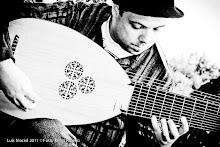
As the picture shows, this instrument also has a half-pear shape and to date is commonly used in music of the Middle East and Eastern Mediterranean countries. It differs from the European lute for not having frets (traces on the neck of the instrument) and because it is played with a plectrum (pick).

The oldest image of an Oud dates back to 5000 years ago, in the current city of Nassiriyah in Iraq. This detail caused me enormous impact, because it is possible to imagine the ancient civilizations of the Middle East and Mediterranean already using chordophones (string instruments) in their music. From the Sumerians, Acadians, Persians, Babylonians, Assyrians, Armenians, Greeks, Egyptians and Romans, to the Turks, who later brought the Oud to the battles, by the belief in the magical powers of this instrument.


(português)
No ano de 711, uma linhagem de muçulmanos extremamente avançados invadiu a Península Ibérica mal defendida e estabeleceu o Califado de Al-Andalus.
Os árabes, entre muitas coisas, estabeleceram na Península o gosto pelas artes e o culto erudito de um instrumento musical chamado “oud” (“Ud” em alguns países) que mais tarde daria origem ao alaúde europeu. Foram também os primeiros a estabelecer em Espanha um conservatório de música através do virtuoso da época, Zyriab.

Como a imagem mostra, este instrumento também tem formato de meia-pêra e até aos dias de hoje é comumente usado na música do Médio Oriente e países do Mediterrâneo Oriental. Distingue-se do alaúde europeu por não ter trastes (traços no braço do instrumento) e por ser tocado com palheta.

A imagem mais antiga de um Oud remonta a 5000 anos atrás, na atual cidade de Nassiriyah no Iraque. Esse detalhe causou-me enorme impacto, pois é possível imaginar as civilizações da Antiguidade no Médio Oriente e Mediterrâneo já usando cordofones (instrumentos de corda) na sua música. Dos Sumérios, Acadianos, Persas, Babilônios, Assírios, Armémios, Gregos, Egípcios e Romanos até aos Turcos, que mais tarde traziam o Oud para as batalhas, pela crença nos poderes mágicos desse instrumento.

Tuesday, March 17, 2009

The Vihuela | A Vihuela


Argentine vihuelist Ariel Abramovich

The vihuela, also known as “Viola da mano” or “Spanish lute”, was an ingenious creation of the iberian lutenists. Around the time when the Kingdom of Granada fell to the Catholic Kings of Spain, the Inquisition of the Iberian countries (Portugal and Spain), concerned in their murderous madness to eliminate all the traces left by the muslims, reached also the universe of music. The lute was in essence a descendant of an arabic instrument, and as such, it was prohibited by the authorities.

Thus, the iberian lutenists created a new instrument with the exact sound of the lute, with the same tuning and same way of playing, changing at the same time the aspect of the instrument, which started to have a similar form to the classical guitar that we know and of which is its direct ancestor.

In Portugal, books of "Viola da mano” from the portuguese golden century are still lost, if they ever existed, because of the catastrophic earthquake that destroyed the city of Lisbon in 1755.

In Spain, have the following books for Vihuela:

- “El Maestro” by Luys de Milan (1536)
- “Los seys libros Del Delphin” by Luys de Narvaéz (1538)
- “Tres libros de música” by Alonso Mudarra (1546)
- “Silva de sirenas” by Enríquez de Valderrábano (1547)
- “Libro de música by Vihuela” de Diego Pisador (1552)
- “Orphénica Lyra” by Miguel de Fuenllana (1554)
- “El Pamasso” by Estevam Daça (1576)

Recommended listening:
EL CORTESANO – “Si me Llaman...” – Diego Pisador, Salamanca 1552 – Carpe Diem Records


vihuela Model "Belchior Dias" - Lisbon 1581

(português)
A vihuela, também chamada de "Viola da mano" ou "alaúde espanhol", foi uma criação engenhosa dos alaúdistas ibéricos. Por volta da altura em que o Reino de Granada caiu para os Reis Católicos de Espanha, a Inquisição dos países ibéricos (Portugal e Espanha), preocupada na sua loucura homicida em eliminar todo e qualquer vestígio deixado pelos muçulmanos, atingiu também o universo da música. O alaúde era na sua essência um descendente de instrumento árabe, e como tal foi proibido pelas autoridades.

Assim, os alaúdistas ibéricos criaram um instrumento novo com o exato som do alaúde, com a mesma afinação e a mesma forma de tocar, mudando ao mesmo tempo o aspecto do instrumento, que passou a ter uma forma semelhante à guitarra clássica que conhecemos hoje e da qual é o antepassado direto.

Em Portugal, continuam perdidos se é que existiram, livros de “viola da mano” do Século de Ouro português, devido ao catastrófico terramoto que destruiu a cidade de Lisboa em 1755.

Em Espanha, conhecem-se os seguintes livros de Vihuela:

- “El Maestro” de Luys de Milan (1536)
- “Los seys libros Del Delphin” de Luys de Narvaéz (1538)
- “Tres libros de música” de Alonso Mudarra (1546)
- “Silva de sirenas” de Enríquez de Valderrábano (1547)
- “Libro de música de Vihuela” de Diego Pisador (1552)
- “Orphénica Lyra” de Miguel de Fuenllana (1554)
- “El Pamasso” de Estevam Daça (1576)

Música recomendada:
EL CORTESANO – “Si me Llaman...” – Diego Pisador, Salamanca 1552 – Carpe Diem Records