Showing posts with label ariel abramovich. Show all posts

Thursday, April 23, 2009

EL CORTESANO - "Si me llaman..." Presentation Concert | Concerto de apresentação


EL CORTESANO invites you to the presentation concert of their latest album, "Si me llaman ..." The presentation will take place on Saturday April 25, at 20hs, in the auditorium of Caja Madrid, located in the building of the Casa de las Alhajas (just opposite the monastery of Las Descalzas in the Plaza San Martín) and you can enter through a side street, Hileras, Madrid.

www.elcortesano.com

Personal note: If you are anywhere inside a 2.000km radius of this event, please do yourself a favor and do not miss it! Pick a bus or a fast train, Madrid has excellent transport connections


EL CORTESANO Si la noche haze oscura

(português)
EL CORTESANO convida-o/a para o concerto apresentação do seu último álbum, "Si me llaman ..." A apresentação terá lugar no sábado, dia 25 de abril às 20hs, no auditório da Caja Madrid, localizado no edifício da Casa de las Alhajas (em frente ao Mosteiro de las Alhajas, na Plaza San Martín) e entra-se por uma rua lateral, Hileras, Madrid.

www.elcortesano.com

Nota pessoal: Se você estiver algures dentro de um raio de 2,000km deste evento, por favor faça um favor a si próprio/a e não perca! Use o “autobus” ou o comboio rápido, Madrid têm excelentes ligações de transporte.

Tuesday, March 17, 2009

The Vihuela | A Vihuela


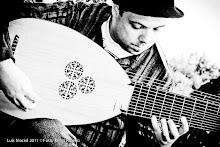
Argentine vihuelist Ariel Abramovich

The vihuela, also known as “Viola da mano” or “Spanish lute”, was an ingenious creation of the iberian lutenists. Around the time when the Kingdom of Granada fell to the Catholic Kings of Spain, the Inquisition of the Iberian countries (Portugal and Spain), concerned in their murderous madness to eliminate all the traces left by the muslims, reached also the universe of music. The lute was in essence a descendant of an arabic instrument, and as such, it was prohibited by the authorities.

Thus, the iberian lutenists created a new instrument with the exact sound of the lute, with the same tuning and same way of playing, changing at the same time the aspect of the instrument, which started to have a similar form to the classical guitar that we know and of which is its direct ancestor.

In Portugal, books of "Viola da mano” from the portuguese golden century are still lost, if they ever existed, because of the catastrophic earthquake that destroyed the city of Lisbon in 1755.

In Spain, have the following books for Vihuela:

- “El Maestro” by Luys de Milan (1536)
- “Los seys libros Del Delphin” by Luys de Narvaéz (1538)
- “Tres libros de música” by Alonso Mudarra (1546)
- “Silva de sirenas” by Enríquez de Valderrábano (1547)
- “Libro de música by Vihuela” de Diego Pisador (1552)
- “Orphénica Lyra” by Miguel de Fuenllana (1554)
- “El Pamasso” by Estevam Daça (1576)

Recommended listening:
EL CORTESANO – “Si me Llaman...” – Diego Pisador, Salamanca 1552 – Carpe Diem Records


vihuela Model "Belchior Dias" - Lisbon 1581

(português)
A vihuela, também chamada de "Viola da mano" ou "alaúde espanhol", foi uma criação engenhosa dos alaúdistas ibéricos. Por volta da altura em que o Reino de Granada caiu para os Reis Católicos de Espanha, a Inquisição dos países ibéricos (Portugal e Espanha), preocupada na sua loucura homicida em eliminar todo e qualquer vestígio deixado pelos muçulmanos, atingiu também o universo da música. O alaúde era na sua essência um descendente de instrumento árabe, e como tal foi proibido pelas autoridades.

Assim, os alaúdistas ibéricos criaram um instrumento novo com o exato som do alaúde, com a mesma afinação e a mesma forma de tocar, mudando ao mesmo tempo o aspecto do instrumento, que passou a ter uma forma semelhante à guitarra clássica que conhecemos hoje e da qual é o antepassado direto.

Em Portugal, continuam perdidos se é que existiram, livros de “viola da mano” do Século de Ouro português, devido ao catastrófico terramoto que destruiu a cidade de Lisboa em 1755.

Em Espanha, conhecem-se os seguintes livros de Vihuela:

- “El Maestro” de Luys de Milan (1536)
- “Los seys libros Del Delphin” de Luys de Narvaéz (1538)
- “Tres libros de música” de Alonso Mudarra (1546)
- “Silva de sirenas” de Enríquez de Valderrábano (1547)
- “Libro de música de Vihuela” de Diego Pisador (1552)
- “Orphénica Lyra” de Miguel de Fuenllana (1554)
- “El Pamasso” de Estevam Daça (1576)

Música recomendada:
EL CORTESANO – “Si me Llaman...” – Diego Pisador, Salamanca 1552 – Carpe Diem Records